The Road to Artificial Intelligence
A 15-part AI Frontier series tracing the history of artificial intelligence—from humanity's earliest information technologies to neural networks, transformers, foundation models, and today's AI frontier.
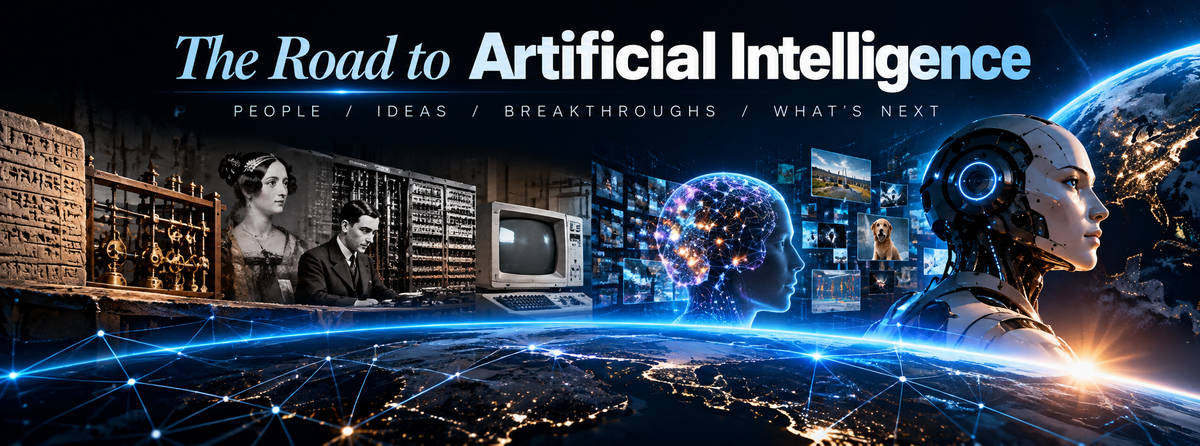
Artificial intelligence did not appear suddenly. It emerged from a long history of human attempts to preserve knowledge, formalize reasoning, automate calculation, and build machines capable of learning from data.
The Road to Artificial Intelligence is a 15-part AI Frontier series tracing that story—from humanity's earliest information technologies to mechanical calculation, electronic computing, neural networks, transformers, foundation models, and today's rapidly changing AI frontier.
This is not a story of inevitable technological progress. At every stage, discoveries, failures, economic pressures, institutions, wars, investments, and human choices shaped what came next.
Understanding that history gives us a better way to understand artificial intelligence today: what these systems can do, where their limitations come from, and which questions remain unresolved.
Start with Part 1 below and follow the road from the earliest attempts to place knowledge outside the human mind to the AI systems being built today.
The Series
Part 1 — What Had to Happen Before Artificial Intelligence?
Before computers could think, humans first had to learn how to preserve knowledge outside the mind. The journey begins with tools, records, counting, and the earliest foundations of information.
Part 2 — From Counters to Programs
From ancient counting devices to mechanical calculators and programmable machines, the story moves from recording quantities to building machines that could automate calculation.
Part 3 — Logic, Signals, and the Machines That Came Before AI
Boolean logic, telegraph signals, punched-card tabulation, and electrical switching helped transform information into something machines could represent and process.
Part 4 — From Symbols to Stored Programs
Formal logic, wartime computing, and stored-program architecture began bringing previously separate ideas about symbols, memory, and electronic calculation together into the foundations of the modern computer.
Part 5 — When Machines Began to Think
As programmable computers emerged, researchers began asking a new question: could machines do more than calculate? Ideas from computing and cybernetics helped turn machine intelligence into a serious field of research.
Part 6 — The First AI Boom
From language programs and miniature worlds to Shakey and DENDRAL, early AI demonstrations created remarkable optimism—and began exposing the gap between impressive demonstrations and broader intelligence.
Part 7 — When AI Hit the Wall
AI's early promises collided with technical limitations, funding pressures, and growing criticism, contributing to the uneven downturn later remembered as the first AI winter.
Read Part 7 →
Part 8 — Expert Systems and AI's Comeback
Expert systems brought artificial intelligence into commercial applications, but systems such as XCON also revealed the difficulties of capturing and maintaining human expertise as rules.
Read Part 8 →
Part 9 — The Neural Network Revival
As expert systems and specialized hardware lost momentum, neural networks, statistical methods, and new approaches to learning continued developing through AI's second winter.
Read Part 9 →
Part 10 — Data, GPUs and Deep Learning
In 2012, AlexNet demonstrated what could happen when neural networks, large datasets, GPUs, and improved training methods came together—helping ignite the deep-learning era.
Read Part 10 →
Part 11 — Machines Learn to See, Play and Predict
From computer vision and language to Atari and AlphaGo, deep learning expanded into new domains while revealing an important distinction between powerful narrow capabilities and general intelligence.
Read Part 11→
Part 12 — The Transformer Changes Everything
Attention mechanisms and the 2017 Transformer opened a new path for language processing, helping enable GPT, BERT, large-scale pretraining, and the modern large language model.
Read Part 12→
Part 13 — The Foundation Model Era
Scaling, human feedback, and increasingly general-purpose foundation models transformed AI systems into platforms capable of supporting a growing range of applications.
Read Part 13→
Part 14 — The AI Arms Race
Frontier AI became more than a competition between models. Chips, data centers, energy, investment, regulation, and global competition increasingly shaped the development of artificial intelligence.
Read Part 14→
Part 15 — Where the Frontier Leads Next
From humanity's earliest efforts to place knowledge outside the mind to today's foundation models and AI agents, the final chapter asks what the history of artificial intelligence can—and cannot—tell us about where the frontier leads next.
Read Part 15→