From Symbols to Stored Programs
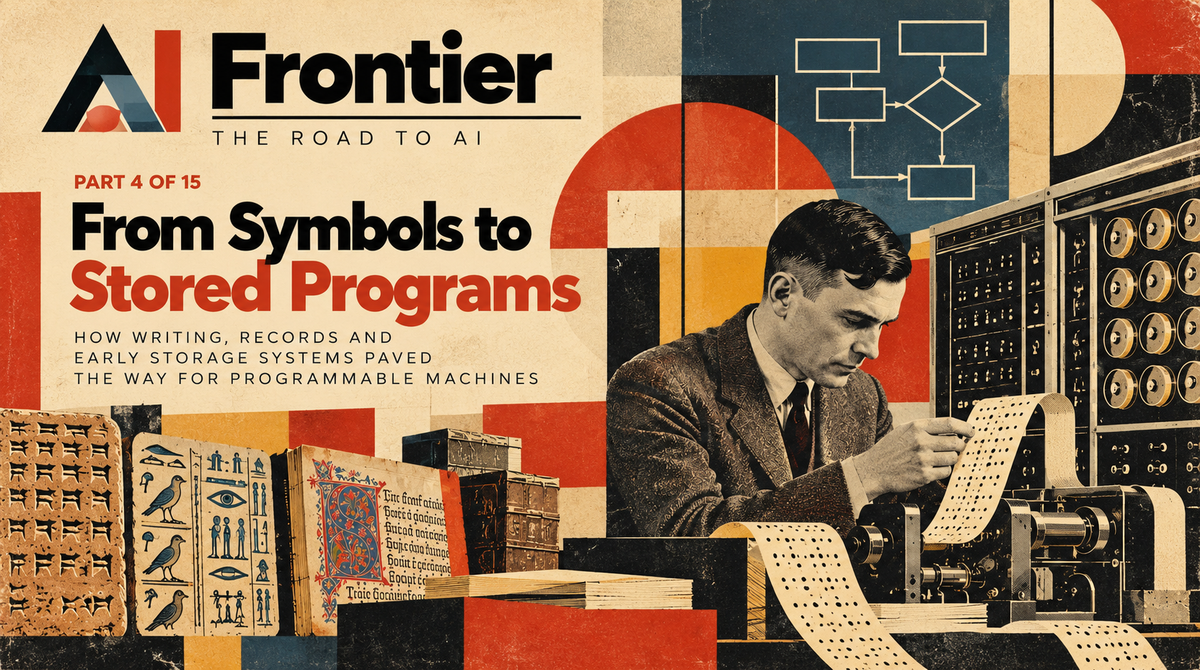
From formal logic and wartime computing to stored-program architecture, Article 4 traces how separate ideas about symbols, memory and electronic calculation began converging into the modern computer.

The Road to Artificial Intelligence — Part 4 of 15
WHEN THE PROGRAM MOVED INSIDE THE MACHINE
The history of logic, signals, and early calculating machines established several foundations of computing. Modern artificial intelligence, however, required another transformation: machines that could represent instructions and manipulate symbols electronically.
No single inventor or birthplace can claim that transformation. It emerged from overlapping work in mathematical logic, mechanical calculation, electronic engineering, wartime codebreaking, and university research.
By the late 1940s, several machines had demonstrated different pieces of the puzzle. Some were programmable but mechanical. Others were electronic but specialized. Still others could store instructions in memory and execute them electronically.
These distinctions matter. AI did not appear simply because computers became more powerful. Its development also depended on computing becoming flexible enough to represent and execute many different kinds of procedures.
An abstract machine
In 1936, Alan Turing published "On Computable Numbers, with an Application to the Entscheidungsproblem." The paper addressed a problem in mathematical logic: whether a general effective procedure exists for deciding if any given formula of first-order logic is logically valid.
Turing described an abstract device, now called a Turing machine, that reads and writes symbols on an unbounded tape according to a set of rules. He had not designed a practical electronic computer. He showed instead how calculation could be described as a sequence of simple symbolic operations. His universal machine could, in principle, simulate other machines if their instructions were encoded in a suitable form.
This was a theory of computation, not a hardware blueprint. It nevertheless gave people a powerful language for thinking about what machines could calculate.
Mechanical and electromechanical experiments
During the same period, engineers were building physical calculating machines.
Konrad Zuse's Z1, built from 1936 to 1938, was a mechanical, binary, program-controlled machine. His Z3, completed in 1941, was an electromechanical binary computer that took its programs from punched film, and it was one of the earliest functioning programmable automatic digital computers.
The Z3's control structure was limited compared with later stored-program computers, and its handling of conditional behavior remains technically complicated. Even so, it showed that binary calculation and programmable control could be combined in a working machine. It also showed that programmable computing did not come from a single national or institutional tradition. Several groups were exploring related possibilities independently.
Electronics enters the picture
Electronic components offered speeds that mechanical switches could not match.
John Atanasoff and Clifford Berry developed the Atanasoff–Berry Computer, or ABC, at Iowa State College between 1939 and 1941, when wartime circumstances interrupted the project. It was an early electronic digital machine designed to solve large systems of linear algebraic equations. It used binary arithmetic and electronic circuitry, but it was a special-purpose machine, not a general-purpose computer.
Whether the ABC qualifies as “the first electronic digital computer” depends on the definition. It is more precisely described as one of the earliest important electronic digital calculating machines and a major contribution to the history of electronic computation.
The distinction is crucial. "Electronic," "digital," "programmable," and "general-purpose" describe different properties, and a machine can have some without having all of them.
Colossus and wartime computing
During the Second World War, the need to analyze encrypted communications accelerated computer development.
At Bletchley Park, British engineers built Colossus to assist with the cryptanalysis of German Lorenz communications. It was operational by early 1944 and used electronic digital circuits. Its settings could be configured through switches, plugboards, and other controls, which made it programmable in a broad sense.
Colossus was among the earliest operational electronic digital machines with programmable control. It remained a specialized cryptanalytic system, not a stored-program general-purpose computer. Its wartime role was highly significant, since it contributed to Allied intelligence, but claims that it shortened the war by a precise number of months are harder to establish and should be treated cautiously.
The people who operated and supported such systems also belong in this history. Women made up a large proportion of the later Bletchley Park workforce, doing technical, operational, cryptanalytic, and administrative work. The history of wartime computing cannot be reduced to a few famous male engineers.
ENIAC: electronic and programmable, but not stored-program
In the United States, the University of Pennsylvania's Moore School developed ENIAC for the U.S. Army. The project began during the war, final assembly took place in the fall of 1945, and the machine was formally dedicated on February 15, 1946.
ENIAC was electronic, digital, and programmable. Its original programming method, however, was physical: programmers connected cables, set switches, and configured function tables to specify the machine's operations.
Six women are especially associated with this work: Kathleen McNulty, Frances Bilas, Jean Jennings, Ruth Lichterman, Marlyn Wescoff, and Frances Snyder. They worked out the logical sequences required for calculations, configured cables and switches, tested and debugged programs, interpreted input and output, and learned the machine from diagrams before complete manuals or programming languages existed.
They were not the only people involved. ENIAC depended on a much larger engineering, military, and university workforce. Still, calling these six women prominent original ENIAC programmers is justified, and it corrects an older history that often made their work invisible.
ENIAC is often called the first general-purpose electronic computer, particularly when “general-purpose” refers to its ability to be adapted to different numerical tasks rather than being dedicated to a single calculation. Its programming model and architecture, however, differed substantially from those of later stored-program computers.
The stored-program idea
The next major step was to place encoded instructions in memory, where the machine could fetch and execute them. Keeping instructions and data in the same memory became one influential form of this approach, though it was not the only defining feature of stored-program design.
First Draft of a Report on the EDVAC, distributed on June 30, 1945, described an architecture organized around memory, arithmetic operations, control, input, and output. It became highly influential in explaining the stored-program approach.
The idea should not be credited exclusively to John von Neumann. It emerged from discussions involving von Neumann, J. Presper Eckert, John Mauchly, Herman Goldstine, Arthur Burks, and others.
The design offered flexibility. Instead of physically rewiring a machine for each new task, operators could load a new sequence of instructions into memory. This allowed the computer to become more than a fast calculator: it could serve as a general mechanism for processing encoded procedures.
Manchester's small proof of concept
On June 21, 1948, the Manchester Baby successfully ran a stored program. The experimental machine used Williams–Kilburn tube memory to hold both instructions and data electronically. Its first program was deliberately small: it searched for the highest factor of a number.
The Baby was not designed as a practical production computer; its importance was in demonstrating that a machine could store a program electronically and execute it from memory.
EDSAC makes the idea useful
At Cambridge, Maurice Wilkes and his colleagues developed EDSAC, which ran its first successful program on May 6, 1949, computing a table of squares. While the Baby primarily demonstrated that stored-program computing could work, EDSAC was designed for regular scientific use.
Labels such as "first" therefore need care. Different machines can be first in different ways: first electronic, first programmable, first stored-program, first practical, or first in regular operation.
The transistor changes the components
On December 16, 1947, John Bardeen and Walter Brattain achieved transistor action in a working point-contact semiconductor amplifier at Bell Laboratories. William Shockley directed the research group and had initiated its semiconductor-amplifier program. After Bardeen and Brattain's breakthrough, he developed the junction-transistor concept.
The transistor did not immediately replace vacuum tubes, and transistorized computing emerged gradually over the following years. It did, however, offer a path toward smaller, more reliable, and more efficient computers.
The transition was gradual. Stored-program architecture increased the flexibility of computers, while improved components made them increasingly practical. Together, these developments created conditions for later advances in software, data processing, and machine intelligence.
The connection to AI
AI requires more than fast arithmetic. It needs machines that can manipulate symbols, follow sequences of instructions, store intermediate results, and apply different procedures to different problems.
The developments described here contributed several of those capabilities:
- Mathematical logic provided formal ways to describe computation.
- Binary electronics made rapid digital operations possible.
- Programmable control allowed machines to perform changing procedures.
- Stored-program architecture allowed encoded instructions to be held in memory and manipulated computationally.
- Improved components made computers more reliable and scalable.
None of this led inevitably to AI. The path also depended on later work in programming languages, statistics, information theory, neuroscience, databases, networking, and machine learning.
The relationship between these developments and AI is best understood in terms of enabling conditions, not as a straight line of technological progress. Stored-program computers created a flexible platform on which many computational ideas, including artificial intelligence, could later be developed.
Looking ahead
Once computers could store and execute changing procedures, new questions began to emerge. Researchers in information theory, cybernetics, logic, and neuroscience started asking whether machines might do more than calculate: whether they could learn, reason, and adapt.
The next article follows the convergence of these ideas and the emergence of artificial intelligence as a named research program.
SOURCES
- Turing, Alan M. "On Computable Numbers, with an Application to the Entscheidungsproblem." Proceedings of the London Mathematical Society, Series 2, Volume 42, 1936; correction in 1937. DOI: 10.1112/plms/s2-42.1.230.
- Konrad Zuse Internet Archive, Zuse Institute Berlin. "Z1" and "Z3." zuse.zib.de/z1; zuse.zib.de/z3. Accessed September 28, 2026.
- Computer History Museum. "Zuse Z1, Z3." The Computer Museum Report, Winter 1983. tcm.computerhistory.org/Timeline/PioneerComputerTimeline2.pdf.
- Iowa State University Library Special Collections and University Archives. "John Vincent Atanasoff Papers, RS 13/20/51." findingaids.lib.iastate.edu/spcl/arch/rgrp/13-20-51.html.
- Iowa State University. "Atanasoff-Berry Computer Operation/Purpose." jva.cs.iastate.edu/operation.php. Accessed September 28, 2026.
- Atanasoff, John V. "Computing Machine for the Solution of Large Systems of Linear Algebraic Equations." John Vincent Atanasoff Collection, Iowa State University Library Digital Collections.
- National Museum of Computing. "Colossus." tnmoc.org/colossus.
- U.S. Army Ordnance Corps. "Electronic Computers Within the Ordnance Corps: ENIAC." 1961. ftp.arl.army.mil/~mike/comphist/61ordnance/chap2.html.
- University of Pennsylvania Archives. "ENIAC Trial Exhibits Master Collection." archives.upenn.edu/collections/finding-aid/upd8_12/.
- Smithsonian Libraries and Archives. "Women's History Month DIY Project." March 29, 2011. blog.library.si.edu/blog/2011/03/29/womens-history-month-diy-project/.
- Smithsonian American Women's History Museum. "Human Computer Project." womenshistory.si.edu/human-computer-project. Accessed September 28, 2026.
- University of Pennsylvania. "On ENIAC's anniversary, a nod to its female 'computers.'" Penn Today, February 11, 2019. penntoday.upenn.edu/news/eniacs-anniversary-nod-its-female-computers.
- IEEE Computer Society. "About Women of ENIAC." computer.org/volunteering/awards/pioneer/about-women-of-eniac.
- University of Manchester. "The Baby." curation.cs.manchester.ac.uk/digital60/www.digital60.org/birth/thebaby/index.html.
- University of Cambridge Computer Laboratory. "The Start of the EDSAC Log." cl.cam.ac.uk/relics/elog.html.
- University of Cambridge Department of Computer Science and Technology. "70 years since the first computer designed for practical everyday use." 2019. cst.cam.ac.uk/news/70-years-first-computer-designed-practical-everyday-use.
- Bardeen, John, and Walter H. Brattain. "The Transistor, A Semi-Conductor Triode." Physical Review, Volume 74, 1948, pages 230–231. DOI: 10.1103/PhysRev.74.230.
- Computer History Museum. "1947: Invention of the Point-Contact Transistor." computerhistory.org/siliconengine/invention-of-the-point-contact-transistor/. Accessed September 28, 2026.
- Nobel Prize Outreach. "William B. Shockley—Facts." nobelprize.org/prizes/physics/1956/shockley/facts/. Accessed September 28, 2026.
- von Neumann, John. First Draft of a Report on the EDVAC. June 30, 1945.
← Previous in the series
Part 3 — Logic, Signals, and the Machines That Came Before AI
Continue the series →