Expert Systems and AI's Comeback
From expert systems and XCON to Japan's Fifth Generation project, Article 8 explores AI's commercial comeback—and the limits of encoding human expertise as rules.

The Road to Artificial Intelligence — Part 8 of 15
WHEN AI BECAME A BUSINESS
In the early 1980s, artificial intelligence seemed ready to leave the laboratory.
The specialized knowledge-based systems developed during the previous era now looked like a practical way forward. Computers were starting to do tasks that once seemed to require human expertise: analyzing chemical compounds, recommending antibiotics, configuring computer systems, and advising mineral explorers.
These programs didn't think broadly, and they didn't learn from experience the way modern machine-learning systems do. They applied carefully written rules drawn from specialists. That limitation was also a strength.
Expert systems showed that AI could be useful without being general. They shifted the question from whether machines could reproduce human intelligence broadly to whether they could reproduce part of an expert's judgment in a narrow, well-defined domain. Sometimes the answer was yes. But building and maintaining these systems proved harder than early enthusiasm suggested.
Expertise became programmable
One of the era's big ideas was that specialist knowledge could be written down explicitly.
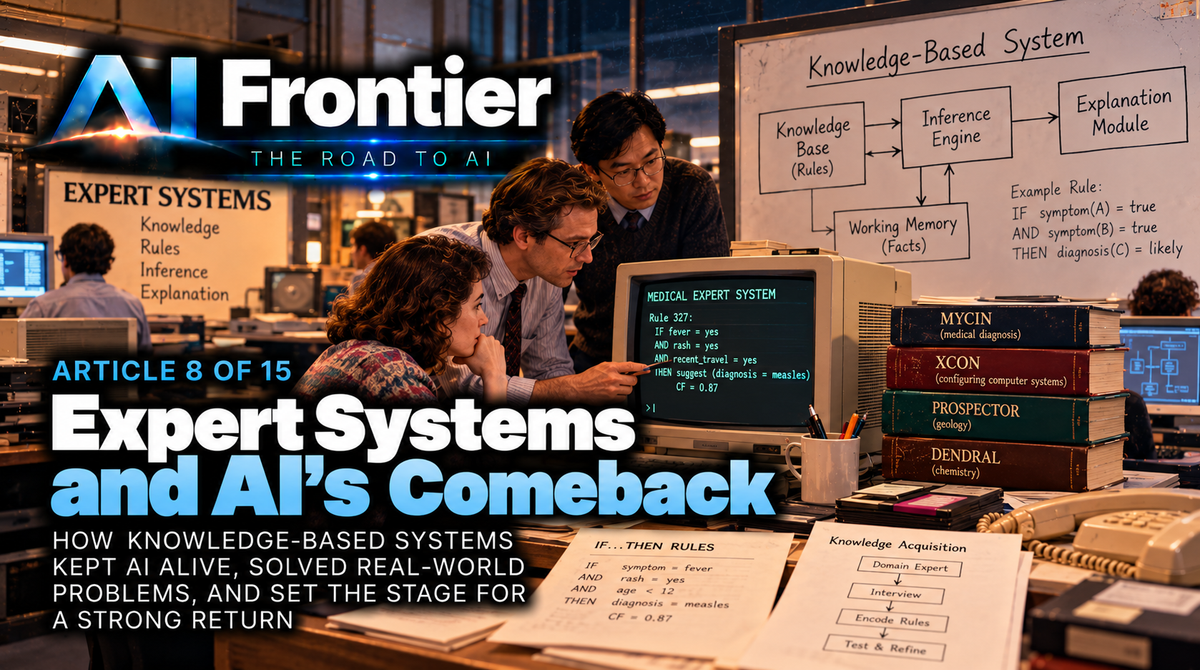
An expert system typically combined a knowledge base of facts and rules, an inference engine that applied those rules, an interface for users to supply information, and, in some systems, an explanation facility that showed how a conclusion was reached.
This approach made intelligence a more concrete engineering problem. Instead of treating it as a mysterious ability, researchers could ask which facts, relationships, and decision procedures an expert actually used.
DENDRAL had already shown the value of pairing general reasoning methods with detailed knowledge of a scientific field. Its importance lay less in broad intelligence than in showing how domain knowledge could make a computer effective at a specialized task. That pattern became central to the expert-system era: narrow knowledge could make up for limited generality.
MYCIN and the challenge of medical judgment
MYCIN, developed at Stanford, applied this approach to infectious disease. It used production rules, backward-chaining consultation, explanation facilities, and certainty factors to help recommend antibiotic treatments. It began with a clinical question and worked backward through relevant rules, asking for information that could help distinguish among possible diagnoses and treatments.
A 1979 evaluation tested MYCIN on ten meningitis cases. Eight infectious-disease specialists judged its recommendations acceptable 65 percent of the time. For recommendations made by five faculty specialists, acceptability ranged from 42.5 to 62.5 percent. Those numbers measured how acceptable the treatments were in a restricted evaluation, not general diagnostic accuracy.
They didn't show that MYCIN was better than physicians, or that it was safe for routine clinical use.
MYCIN was never used routinely in practice. Edward Shortliffe later described it as experimental and pointed to practical barriers, including the lack of an installable system and the difficulty of keeping expert collaboration going. Its nondeployment cannot be attributed to a single cause; practical barriers included the difficulty of installing, maintaining, validating, and integrating such a system into clinical practice. Promising performance in a narrow test simply didn't add up to readiness for a real clinic.
The knowledge-acquisition bottleneck
Expert systems depended on specialists, but getting their knowledge into a computer was hard.
Experts often relied on tacit experience rather than neatly organized knowledge. They might recognize a pattern instantly without being able to explain every step. Knowledge engineers had to translate that expertise into rules, exceptions, priorities, and confidence levels.
This became known as the knowledge-acquisition bottleneck. Edward Feigenbaum's 1982 writings reflected a growing recognition that capturing and formalizing expert knowledge could be more difficult than building the inference software itself.
Maintenance was a second problem. Rules could become outdated, contradict one another, or fail when a system met conditions beyond its original design. An expert system wasn't a finished product; keeping it useful required specialists, engineers, testing, and continual maintenance.
XCON enters the factory
XCON became one of the best-known examples of an expert system deployed inside a large organization.
The project began at Carnegie Mellon as R1 and was developed for Digital Equipment Corporation, which needed help configuring computer systems from many possible components. The first version reached DEC in 1980 with about 750 rules. It grew to roughly 1,000 rules during early maintenance and later reached about 2,500.
Unlike a lab demonstration, XCON became part of DEC's manufacturing process. XCON demonstrated that a rule-based system could become part of a real industrial workflow rather than remain a laboratory prototype.
That success came with costs. As the system grew, maintaining its rules became a continuing technical and organizational job. Contemporary accounts credited XCON with substantial savings at DEC, although precise estimates of its financial impact are difficult to verify independently.
What XCON does support is a narrower conclusion: expert systems could pay off when the environment was structured, the goals were clear, and the organization invested in upkeep.
Shells and the attempt to scale
Researchers soon tried to separate the reusable machinery of an expert system from the specialized knowledge of a particular application.
That produced expert-system shells such as EMYCIN, OPS5, KEE, and ART. A shell could supply an inference engine, knowledge-representation tools, or interface components, so developers could build new applications without starting from scratch.
By reusing the underlying software, shells could reduce the amount of engineering needed to build each new expert system. Reusing software cut down on duplicated effort, though gathering, checking, and maintaining domain knowledge stayed difficult.
The approach also fed commercial interest. Companies began exploring systems for engineering, manufacturing, finance, mineral exploration, and other specialized fields. Commercial interest grew quickly, although experimentation with expert systems was much broader than successful deployment.
PROSPECTOR and the boundaries of evidence
PROSPECTOR was a mineral-exploration consultation system developed at SRI.
A popular story ties PROSPECTOR to the discovery of the Mount Tolman molybdenum deposit. Later accounts have linked PROSPECTOR to the Mount Tolman discovery, but the historical record does not clearly establish that the system itself discovered the deposit.
That uncertainty points to a broader problem in AI history. Systems tend to be remembered through tidy success stories, while the real picture involves software, experts, fieldwork, and institutional decisions all tangled together. Their documented achievements were significant enough without relying on simplified or unverified success stories.
National competition and the Fifth Generation project
Expert systems arrived during a period of intense international competition in computing.
Japan established the Institute for New Generation Computer Technology, or ICOT, on April 14, 1982. Its Fifth Generation Computer Systems project was planned as a ten-year effort, from 1982 to 1991, focused on knowledge processing, logic programming, and parallel computing. A November 1990 Dataquest industry report put MITI's budget at ¥47.7 billion and estimated the total project budget, including participating companies, at more than ¥70 billion. Those figures are best left in yen, since converting them to dollars depends on exchange-rate and accounting assumptions.
The project helped make advanced computing and AI-related research part of national technological strategy. Its goals extended beyond expert systems, reflecting a broader belief that knowledge processing and new computer architectures could transform information technology.
Other countries responded with broader programs. The European Community's ESPRIT covered microelectronics, software, advanced information processing, office systems, and computer-integrated manufacturing, so it wasn't simply an AI program. In the United States, the Microelectronics and Computer Technology Corporation, or MCC, was announced in 1982 and held its first board meeting in 1983. Historical accounts describe MCC as a private-sector response to growing Japanese technological competition, including the Fifth Generation initiative, although its research extended well beyond AI. Britain's Alvey Programme also addressed information technology as a whole. Later parliamentary analysis put its total cost at about £350 million, with £200 million from the government.
Together, these programs show that AI's development was tied to industrial policy, semiconductor research, software engineering, and international rivalry, not just to ideas about machine intelligence.
Lisp machines and specialized hardware
The expert-system era also produced computers built for symbolic programming.
Lisp machines were optimized for Lisp, the language widely used in AI research. MIT's CADR processor, described in a 1979 technical report, was a 32-bit design meant to support high-performance Lisp. These machines often combined hardware and software features useful for symbolic work, such as tagged data, virtual memory, graphics, and development environments, making it easier to build and inspect complex AI programs.
Their advantage was real but temporary. As general-purpose workstations became more powerful and less expensive, the economic case for specialized Lisp hardware weakened, contributing to the industry's decline.
Neural networks did not disappear
The rise of expert systems didn't end other approaches to AI.
Neural-network research continued throughout the period, though it drew less attention than rule-based systems in many commercial and institutional settings. In 1982, John Hopfield published a model showing how networks of connected units could show collective computational behavior and associative memory. Hopfield's work was one prominent example of a broader neural-network research tradition that continued through this period.
This was a different picture of intelligence. Expert systems made knowledge explicit through human-readable rules. Neural networks emphasized patterns emerging from the interactions of many simple components. The two traditions developed unevenly and were often cast as rivals, but both contributed to the longer history of AI. Neither approach disappeared; their influence simply rose and fell at different points in AI's history.
The connection to AI
The expert-system era changed AI in several lasting ways.
First, it showed the value of specialization. A system didn't need broad intelligence to be useful. It could help with configuration, diagnosis, scientific interpretation, or another narrow task.
Second, it made knowledge representation a central engineering problem. Researchers had to decide how to represent facts, rules, uncertainty, explanations, and exceptions.
Third, it exposed the importance of deployment context. MYCIN showed that promising results in a controlled evaluation did not automatically justify clinical deployment. XCON showed that operational value depended on workflow integration, maintenance, and organizational support.
Finally, it revealed a recurring weakness of knowledge-based AI: the world changes, experts disagree, and no fixed set of rules can anticipate every situation. Making a system reason was only part of the challenge. Its knowledge also had to stay accurate, relevant, and up to date.
The expert-system era left lessons that extend well beyond rule-based AI. A strong benchmark or demonstration isn't the same as reliable performance in the world. High-stakes deployment still needs validation, monitoring, human oversight, clear responsibility, and careful maintenance.
Looking ahead
Expert systems showed that parts of specialized human expertise could be represented through explicit rules. They also revealed how difficult that expertise could be to capture, maintain, and apply reliably.
As commercial expectations rose, those limits became harder to ignore. Specialized hardware faced competition from cheaper general-purpose machines, while researchers continued exploring approaches that could learn patterns from data rather than relying mainly on hand-written rules. The next article follows that commercial contraction and the neural-network revival that continued beneath it.
SOURCES
- Victor L. Yu et al., "Antimicrobial Selection by a Computer: A Blinded Evaluation by Infectious Diseases Experts," JAMA, 1979.
- Stephen Polit, "R1 And Beyond: AI Technology Transfer At DEC," AI Magazine, vol. 5, no. 4, 1984. DOI: 10.1609/aimag.v5i4.460.
- John McDermott, "R1: The Formative Years," AI Magazine, vol. 2, no. 2, 1981. DOI: 10.1609/aimag.v2i2.100.
- P. E. Hart, R. O. Duda, and M. T. Einaudi, "PROSPECTOR—A Computer-Based Consultation System for Mineral Exploration," Mathematical Geology, vol. 10, 1978. DOI: 10.1007/BF02461988.
- Edward A. Feigenbaum, "Knowledge Engineering for the 1980s" and "Knowledge Acquisition: The Bottleneck," Stanford archive, 1982.
- Institute for New Generation Computer Technology, "What is FGCS Technologies."
- Institute for New Generation Computer Technology, Proceedings of the International Conference on Fifth Generation Computer Systems, 1984.
- Dataquest Incorporated, Japanese Semiconductor Industry Service: Products, Markets, and Technology, "Fifth-Generation Computer Research Project," November 1990, Computer History Museum archive.
- Thomas F. Knight Jr. et al., "CADR," MIT AI Working Paper AIM-528, 1979.
- John J. Hopfield, "Neural Networks and Physical Systems with Emergent Collective Computational Abilities," Proceedings of the National Academy of Sciences, 1982.
- European Economic Community, "Council Decision 84/130/EEC concerning a European programme for research and development in information technologies (ESPRIT)," 1984.
- UK House of Lords Artificial Intelligence Committee, "AI in the UK: ready, willing and able?", 2018.
- L. Branscomb, "Joint R&D: The Case of Microelectronics and Computer Technology Corporation," Research Policy, vol. 15, no. 5, 1986, pp. 219–231. DOI: 10.1016/0048-7333(86)90023-5.
- Michael Frontain, "Microelectronics and Computer Technology Corporation (MCC)," Handbook of Texas, Texas State Historical Association, accessed September 28, 2026.