Machines Learn to See, Play and Predict
From computer vision and language to Atari and AlphaGo, Article 11 follows deep learning as it expanded into new domains—and revealed the difference between narrow capability and general intelligence.

The Road to Artificial Intelligence — Part 11 of 15
WHEN DEEP LEARNING LEFT THE LAB
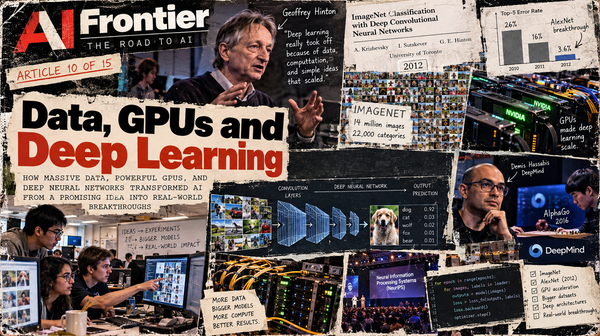
AlexNet made the convergence of neural networks, large datasets, and GPU computation visible. Over the next five years, deep-learning systems got better at computer vision, translated languages, played video games, generated speech, and defeated elite Go players.
It was tempting to call this the arrival of intelligence itself. The reality was more complicated. Deep learning advanced because several things improved together: larger datasets, faster processors, better algorithms, better software, and carefully designed benchmarks.
The period from 2012 to 2017 did not produce general intelligence. It produced something narrower and more consequential: systems exceptionally good at particular tasks.
After AlexNet
The 2012 ImageNet result changed the direction of computer vision. Convolutional neural networks had existed for years, but AlexNet showed that, given enough data and computation, they could beat established methods by a wide margin.
A rapid run of improvements followed. ZFNet, VGG, GoogLeNet, and ResNet posted increasingly strong ImageNet results. Exact scores and rankings varied by model and competition setup, but the trend was clear: CNNs came to dominate the leading systems.
ResNet, introduced in 2015, used "skip connections" that let information move more easily through very deep networks, which made them far easier to train. It didn't eliminate every problem with vanishing gradients, but it let researchers build networks of much greater depth.
Learning representations for language
Computer vision was only one part of the transformation.
In language processing, researchers developed ways to represent words as numerical vectors. Bengio and colleagues demonstrated an important neural language-modeling approach in 2003, learning word representations and language predictions together. A decade later, word2vec made efficient word-vector training widely accessible. Its CBOW and Skip-gram methods learned relationships between words from their surrounding context, so words that appeared in similar contexts tended to end up with similar representations.
These vectors didn't give machines human understanding. They gave language a useful mathematical structure, letting systems measure certain patterns of similarity and analogy.
Sequences, translation, and attention
Recurrent neural networks, including long short-term memory networks, were designed to process sequences. Encoder-decoder systems extended the idea to tasks like translation: one network encoded an input sequence, and another generated an output sequence.
Attention brought a major improvement. Instead of squeezing an entire input into a single fixed representation, a model could weigh different parts of the input as it produced each output. That helped sequence models handle long and varied inputs, though these early attention mechanisms were not the same as the later Transformer.
Google's neural machine translation work showed how these ideas could improve translation at scale. Its researchers reported an average 60 percent reduction in translation errors compared with Google's phrase-based production system. That figure came from human side-by-side evaluations of simple, isolated sentences across selected language pairs, so it doesn't describe translation quality in every setting.
Learning directly from pixels
Deep learning also entered reinforcement learning, where a system learns by taking actions and receiving rewards.
In 2013, DeepMind researchers demonstrated a system that learned to play seven Atari games using only screen images as input. It outperformed previous approaches on six of the seven and scored above the human reference on three. A later Nature paper evaluated the method, known as the deep Q-network, or DQN, across 49 games against a professional human game tester. Results varied a lot from game to game, and "human-level" referred to performance under that specific evaluation, not a general ability to play games or reason like a person.
Even so, DQN mattered because it connected visual perception, decision-making, and reward learning in a single system.
AlphaGo and the power of combining methods
One of the most widely discussed demonstrations of the period came from Go.
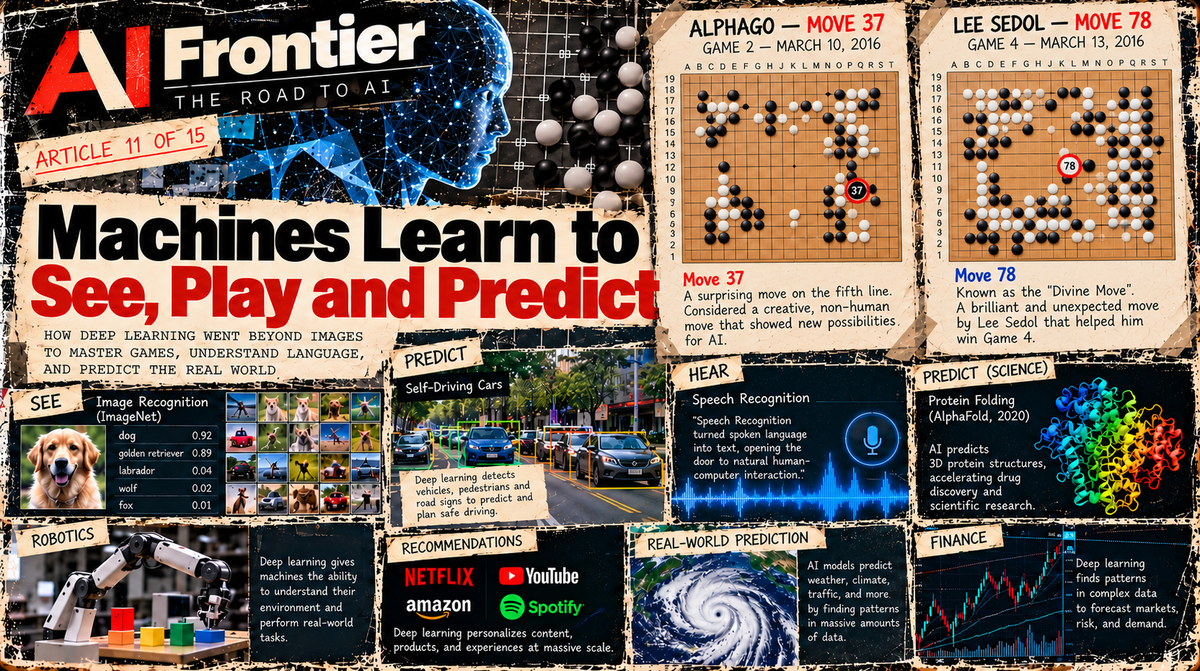
Go's enormous search space made brute force impractical. AlphaGo combined neural networks that estimated promising moves and positions, reinforcement learning, and tree search. In October 2015, it defeated European champion Fan Hui five games to zero, a result reported in a 2016 Nature paper. In March 2016, it defeated Lee Sedol four games to one.
The match drew attention partly because some moves surprised human commentators. DeepMind reported that, by its data, Move 37 in the second game had a one-in-10,000 chance of being played by a human. That's a company estimate, not an independent measure of machine creativity.
AlphaGo's success showed the power of combining learned evaluation with search inside a clearly defined game with fixed rules. It was not general intelligence.
It also lost a game. In the fourth, Lee Sedol's unexpected Move 78 became the turning point. AlphaGo gave the move a very low probability and failed to respond effectively, which gave Lee his only win. The episode showed how extraordinary benchmark performance could coexist with striking weaknesses.
AlphaGo Zero: less human data, not no human design
In 2017, DeepMind introduced AlphaGo Zero. Unlike the earlier system, it trained through self-play without human game records, starting from the rules of Go and playing against itself. The researchers reported that it defeated the previously published AlphaGo 100 games to zero.
The result showed that strong performance could emerge from self-play and search without imitating human experts. Still, "without human knowledge" needs careful reading. The system relied on human-designed algorithms, network architectures, computing infrastructure, and the formal rules of the game.
The infrastructure beneath the results
Behind these systems were major changes in computing infrastructure.
NVIDIA's cuDNN library made common neural-network operations more efficient, and distributed systems let computation spread across many machines. Google's TensorFlow, described in 2016, offered a framework for building and running computational graphs across CPUs, GPUs, and other hardware. Open-source software put important tools in the hands of people outside the labs that built them, though large-scale data and computing remained expensive.
Google also described its first-generation Tensor Processing Unit in 2016, with a technical paper in 2017. Designed mainly for neural-network inference in data centers, the TPU showed large speed and performance-per-watt advantages over contemporary CPU and GPU systems on the workloads Google tested. Those results shouldn't be stretched to every machine-learning task.
Together, these developments widened access. Pretrained models, cloud computing, and open-source frameworks lowered some barriers to experimentation. Access stayed unequal, though, and large datasets and specialized hardware kept favoring well-funded organizations.
The connection to AI
By the mid-2010s, deep learning was more than a breakthrough in image recognition.
Neural networks learned useful representations from large datasets, while GPUs and specialized processors sped up training. Better software made experiments easier to build and reproduce, and benchmarks such as ImageNet, Atari, and Go gave researchers clear targets. Together, these advances expanded what machine-learning systems could do across images, speech, language, games, and other structured tasks.
The benchmarks also exposed limits. ImageNet measured classification. Atari measured performance in specific games. Go offered a closed world with fixed rules. Success in one environment didn't automatically carry over to another.
That marked a distinction between capability and generality. A system could be highly capable in a narrow domain and brittle outside it. Research on adversarial examples showed that small, deliberately designed changes could make neural networks fail with confidence, and performance could depend heavily on the data, hardware, and evaluation method.
The deep-learning surge came from no single invention, and its successes were not a straight path toward human-like intelligence.
Looking ahead
Attention began as an add-on to recurrent sequence models. The next article follows its development into the core of a new architecture, the Transformer, which would reshape language processing and make large-scale pretraining central to AI research.
SOURCES
- Yoshua Bengio, Réjean Ducharme, Pascal Vincent and Christian Jauvin, "A Neural Probabilistic Language Model," Journal of Machine Learning Research 3, 2003. jmlr.org/papers/v3/bengio03a.html
- Alex Krizhevsky, Ilya Sutskever and Geoffrey E. Hinton, "ImageNet Classification with Deep Convolutional Neural Networks," Advances in Neural Information Processing Systems 25, 2012. proceedings.neurips.cc/paper/2012/hash/c399862d3b9d6b76c8436e924a68c45b-Abstract.html
- Matthew D. Zeiler and Rob Fergus, "Visualizing and Understanding Convolutional Networks," European Conference on Computer Vision, 2014, pp. 818–833. DOI: 10.1007/978-3-319-10590-1_53
- Karen Simonyan and Andrew Zisserman, "Very Deep Convolutional Networks for Large-Scale Image Recognition," International Conference on Learning Representations, 2015. arxiv.org/abs/1409.1556
- Christian Szegedy et al., "Going Deeper with Convolutions," Proceedings of the IEEE Conference on Computer Vision and Pattern Recognition, 2015, pp. 1–9. openaccess.thecvf.com/content_cvpr_2015/html/Szegedy_Going_Deeper_With_2015_CVPR_paper.html
- Kaiming He, Xiangyu Zhang, Shaoqing Ren and Jian Sun, "Deep Residual Learning for Image Recognition," Proceedings of the IEEE Conference on Computer Vision and Pattern Recognition, 2016, pp. 770–778. openaccess.thecvf.com/content_cvpr_2016/html/He_Deep_Residual_Learning_CVPR_2016_paper.html
- Tomas Mikolov, Kai Chen, Greg Corrado and Jeffrey Dean, "Efficient Estimation of Word Representations in Vector Space," arXiv:1301.3781, 2013. arxiv.org/abs/1301.3781
- Tomas Mikolov, Ilya Sutskever, Kai Chen, Greg S. Corrado and Jeff Dean, "Distributed Representations of Words and Phrases and their Compositionality," Advances in Neural Information Processing Systems 26, 2013. proceedings.neurips.cc/paper/2013/hash/9aa42b31882ec039965f3c4923ce901b-Abstract.html
- Sepp Hochreiter and Jürgen Schmidhuber, "Long Short-Term Memory," Neural Computation 9, no. 8, 1997, pp. 1735–1780. DOI: 10.1162/neco.1997.9.8.1735
- Kyunghyun Cho et al., "Learning Phrase Representations using RNN Encoder–Decoder for Statistical Machine Translation," Proceedings of the 2014 Conference on Empirical Methods in Natural Language Processing, 2014, pp. 1724–1734. DOI: 10.3115/v1/D14-1179
- Ilya Sutskever, Oriol Vinyals and Quoc V. Le, "Sequence to Sequence Learning with Neural Networks," Advances in Neural Information Processing Systems 27, 2014. proceedings.neurips.cc/paper/2014/hash/5a18e133cbf9f257297f410bb7eca942-Abstract.html
- Dzmitry Bahdanau, Kyunghyun Cho and Yoshua Bengio, "Neural Machine Translation by Jointly Learning to Align and Translate," International Conference on Learning Representations, 2015. arxiv.org/abs/1409.0473
- Yonghui Wu et al., "Google's Neural Machine Translation System: Bridging the Gap between Human and Machine Translation," arXiv:1609.08144, 2016. arxiv.org/abs/1609.08144
- Volodymyr Mnih et al., "Playing Atari with Deep Reinforcement Learning," arXiv:1312.5602, 2013. arxiv.org/abs/1312.5602
- Volodymyr Mnih et al., "Human-level Control through Deep Reinforcement Learning," Nature 518, 2015. DOI: 10.1038/nature14236
- David Silver et al., "Mastering the Game of Go with Deep Neural Networks and Tree Search," Nature 529, 2016. DOI: 10.1038/nature16961
- Google, "What We Learned in Seoul with AlphaGo," March 17, 2016. blog.google/innovation-and-ai/products/what-we-learned-in-seoul-with-alphago/
- Google DeepMind, "AlphaGo," accessed September 28, 2026. deepmind.google/research/alphago/
- British Go Association, "Google DeepMind Challenge Match—Lee Sedol v AlphaGo—Match Report," 2016. britgo.org/alphago-leesedol
- David Silver et al., "Mastering the Game of Go without Human Knowledge," Nature 550, 2017. DOI: 10.1038/nature24270
- Sharan Chetlur et al., "cuDNN: Efficient Primitives for Deep Learning," arXiv:1410.0759, 2014. arxiv.org/abs/1410.0759
- Norman P. Jouppi et al., "In-Datacenter Performance Analysis of a Tensor Processing Unit," ISCA 2017.
- Martín Abadi et al., "TensorFlow: A System for Large-Scale Machine Learning," OSDI 2016.
- Christian Szegedy et al., "Intriguing Properties of Neural Networks," arXiv:1312.6199, 2013.
- Official ImageNet organizers, "ImageNet Large Scale Visual Recognition Competition 2013 Results."