Logic, Signals, and the Machines That Came Before AI
From Boolean logic and telegraph signals to punched-card tabulation and electrical switching, Article 3 traces the technologies and ideas that helped turn information into something machines could process.

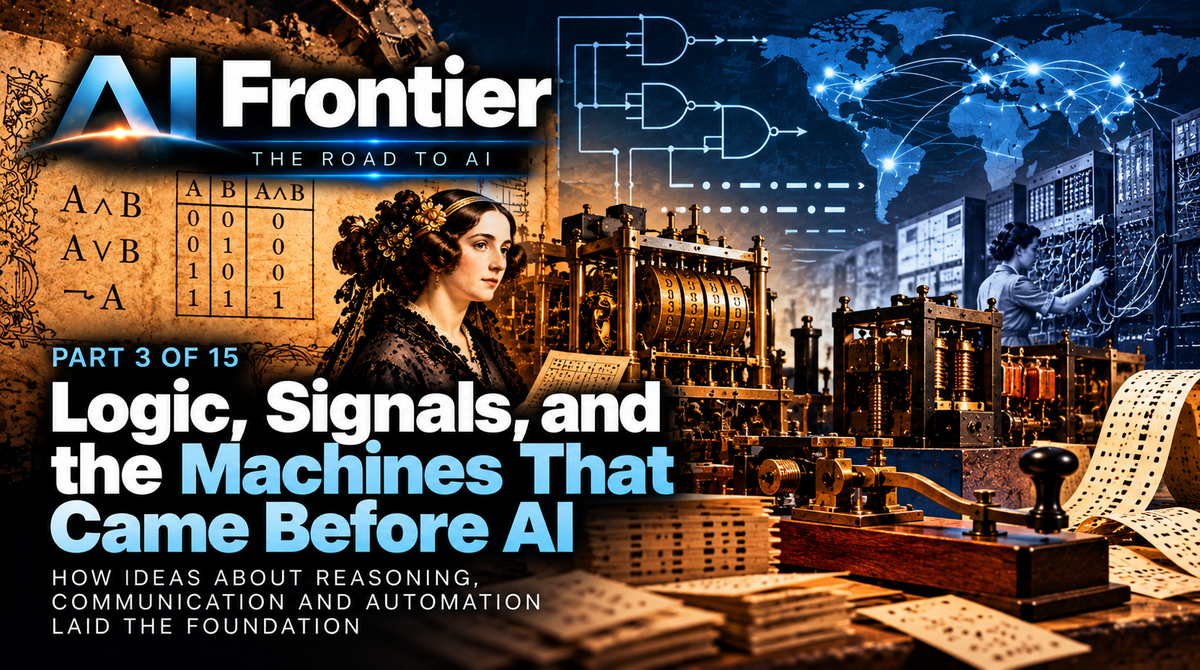
The Road to Artificial Intelligence — Part 3 of 15
When information became signal
Mechanical calculators and punched controls showed that devices could perform operations, or change their behavior, according to external instructions. Modern computing, however, required several other traditions to converge.
Mathematicians sought to express reasoning in symbols. Communication systems encoded messages as signals. Tabulating machines manipulated coded records. Engineers developed mathematical methods for describing electrical switching.
None of these technologies was conceived as a step toward artificial intelligence. Their creators pursued more immediate goals: understanding logic, speeding up government statistics, improving communication, or controlling electrical circuits. Their connections to modern computing became visible only later.
Turning reasoning into symbols
In 1847, George Boole published The Mathematical Analysis of Logic. Seven years later, he expanded the project in An Investigation of the Laws of Thought.
Boole treated parts of logical reasoning as algebraic operations. His system was not identical to the Boolean algebra used in modern digital circuits, and later contributors, including W. Stanley Jevons, helped develop a more general algebraic logic.
Boole had not designed a computer. His contribution was conceptual: reasoning could be described through formal symbols and rules. That possibility would eventually make it easier to describe machines whose operations depended on logical choices.
Machines for mechanical inference
Jevons explored whether logical inference could be mechanized. His 1870 paper, "On the Mechanical Performance of Logical Inference," described a device commonly associated with the Logic Piano.
The machine could help derive conclusions from premises entered into it. It was neither an autonomous thinker nor a general-purpose computer, but a specialized mechanism for a limited form of symbolic reasoning. Even so, it demonstrated that rules expressed in symbols could be connected to physical operations.
Signals become coded records
In the nineteenth century, telegraphy showed how information could be represented as patterns of discrete signals. The system that became known as Morse code emerged through the work of Samuel Morse and Alfred Vail, using patterns of dots and dashes to represent characters. Morse's early apparatus recorded these patterns on paper for an operator to interpret later, and operators eventually learned to read the signals by sound.
Morse's system is therefore better described as an early form of discrete coded communication than simply as "digital communication." Modern digital systems can use formal encodings that machines store, manipulate, and transmit automatically. Telegraphy established part of the underlying idea, that messages could be represented by selected signal patterns, but not the whole modern system.
Hollerith and the punched record
The United States Census Office faced a different challenge: processing enormous quantities of statistical information.
Herman Hollerith developed a system in which holes in cards represented information about individual records. Electrical contacts detected the holes, allowing counters to compile totals. His 1889 patents described both the punched-record method and the apparatus used to process it, and the Census Bureau reports that the system was used for the 1890 census.
In an 1888 competition, contestants processed 1880 census data from four areas of St. Louis. Hollerith completed the data-capture stage, transferring information from census schedules into machine-readable form, in 72.5 hours. He then prepared the data for tabulation by categories such as age, race, and sex in 5.5 hours.
His apparatus was an electrical or electromechanical tabulating system, not an electronic computer or a general-purpose machine. Unlike Jacquard's punched cards, which helped control a sequence of operations in weaving, Hollerith's cards represented data to be counted and sorted. The system's effectiveness came from its specialization in a clearly defined task.
A later IBM account says Hollerith was inspired by railway tickets bearing punched descriptions of passengers. That story is best treated as an attributed company account, not an independently established fact.
Hollerith later founded the Tabulating Machine Company, whose corporate lineage passed through the Computing-Tabulating-Recording Company and eventually became IBM. Punched cards would remain central to data processing for decades.
Logic enters electrical switching
The connection between formal logic and electrical circuits emerged through more than one line of development.
In an 1886 letter to Allan Marquand, Charles Sanders Peirce suggested that electricity could be used to build logical machines. He illustrated series and parallel arrangements of switches and related them to operations in his algebra of logic. The proposal did not amount to a complete theory of relay circuits, but it documents an early connection between formal logic and electrical switching.
Decades later, engineers and mathematicians approached the problem more systematically. Relay circuits could be open or closed, and networks could be arranged so that particular combinations of inputs produced particular outputs. That made them natural candidates for algebraic description.
Parallel developments in the 1930s
During the 1930s, researchers in several countries developed related ideas about relay circuits.
In Japan, Akira Nakashima published work on relay circuits beginning in 1934 and presented research on relay-network synthesis in 1935. In 1936, he worked with Masao Hanzawa on algebraic design methods. His work appears to have developed independently of Claude Shannon's, although questions of priority and possible communication require careful treatment.
In the Soviet Union, Victor Shestakov developed a Boolean-algebraic theory of electrical switching in the mid-1930s. His 1935 manuscript, "Algebra of Relay Circuits," remained unpublished. He defended a dissertation on constructing and simplifying two-terminal electrical networks in 1938, and his first published account appeared in 1941. The gaps between development, dissertation, and publication complicate priority claims.
Together, these developments show that the connection between logic and switching did not arise from a single insight.
Shannon's bridge between algebra and circuits
Claude Shannon's 1937 master's thesis, published in 1938 as "A Symbolic Analysis of Relay and Switching Circuits," gave one of the clearest formal treatments of the subject.
Shannon showed that algebraic methods associated with Boolean-style logic could describe relay and switching circuits. Instead of analyzing every physical component separately, engineers could represent circuit behavior symbolically and use algebra to design or simplify networks. The work provided a powerful bridge between abstract logic and practical engineering.
It did not create artificial intelligence, and without stronger evidence it should not be treated as a direct blueprint for later wartime computers. Its contribution was more fundamental: it helped establish a common language in which physical switching systems could represent logical operations.
The connection to AI
Modern AI depends on several layers of abstraction. Information must be represented. Operations must be specified. Systems must manipulate symbols, numbers, or patterns according to rules. Hardware must implement those operations reliably and at scale.
The developments described here contributed to different parts of that foundation:
- Boole and later logicians showed that reasoning could be expressed formally.
- Jevons demonstrated that some symbolic inference could be mechanized.
- Telegraphy showed how messages could be encoded as signal patterns.
- Hollerith demonstrated the practical value of machine-readable records and automated counting.
- Peirce, Nakashima, Shestakov, and Shannon connected logical descriptions with electrical switching.
These were not early AI systems. They did not learn, understand language, or function as general-purpose computers. Their later significance lies in the possibilities they helped make technically achievable.
The convergence was retrospective, not planned. Logic, statistics, communication, and electrical engineering developed for different reasons before later computing systems brought them together.
Looking ahead
By the late 1930s, formal logic could describe switching networks, coded information could be processed mechanically, and programmable designs had already been imagined. These strands would eventually come together in machines that could store instructions and data, manipulate information in general ways, and operate electronically at far greater speed.
The next article, "From Symbols to Stored Programs," follows that convergence and the emergence of the architecture on which later artificial intelligence would depend.
SOURCES
- George Boole, The Mathematical Analysis of Logic, Being an Essay Towards a Calculus of Deductive Reasoning, Macmillan, Barclay, & Macmillan, 1847.
- George Boole, An Investigation of the Laws of Thought on Which Are Founded the Mathematical Theories of Logic and Probabilities, Walton and Maberly, 1854.
- "George Boole," Stanford Encyclopedia of Philosophy, revised March 1, 2026.
- W. Stanley Jevons, "On the Mechanical Performance of Logical Inference," Philosophical Transactions of the Royal Society, vol. 160, 1870, pp. 497–518. DOI: 10.1098/rstl.1870.0022.
- Library of Congress, "Invention of the Telegraph," Samuel F. B. Morse Papers at the Library of Congress, 1793 to 1919, accessed September 28, 2026.
- Smithsonian Institution Archives, "A Forgotten History: Alfred Vail and Samuel Morse," May 11, 2011.
- Herman Hollerith, "Art of Compiling Statistics," U.S. Patent No. 395,782, January 8, 1889.
- Herman Hollerith, "Apparatus for Compiling Statistics," U.S. Patent No. 395,783, January 8, 1889.
- U.S. Census Bureau, "The Hollerith Machine," accessed September 28, 2026.
- U.S. Census Bureau, "About the 1890 Decennial Census."
- Claude E. Shannon, "A Symbolic Analysis of Relay and Switching Circuits," Transactions of the American Institute of Electrical Engineers, vol. 57, no. 12, 1938, pp. 713–723. DOI: 10.1109/ee.1938.6431064.
- Toma Kawanishi, "Prehistory of Switching Theory in Japan: Akira Nakashima and His Relay-circuit Theory," Historia Scientiarum, vol. 29, no. 1, 2019, pp. 136–162. DOI: 10.34336/historiascientiarum.29.1_136.
- Charles Sanders Peirce, "Letter, Peirce to A. Marquand," December 30, 1886, in Writings of Charles S. Peirce: A Chronological Edition, vol. 5, 1884–1886, Peirce Edition Project, Indiana University Press, 1993, pp. 421–423.
- B. V. Biryukov, I. S. Verstin, and V. I. Levin, "The Life and Scientific Career of Victor Ivanovich Shestakov—Creator of the Logical Theory of Relay-Contact Circuits," Logical Investigations, vol. 14, 2007, pp. 27–72. DOI: 10.21146/2074-1472-2007-14-0-27-72.
- V. I. Shestakov, "Algebra of Two-Terminal Circuits Constructed Exclusively from Two-Terminal Elements (Algebra of A-Circuits)," Avtomatika i Telemekhanika, vol. 6, no. 2, 1941, pp. 15–24.
← Previous in the series
Part 2 — From Counters to Programs
Continue the series →